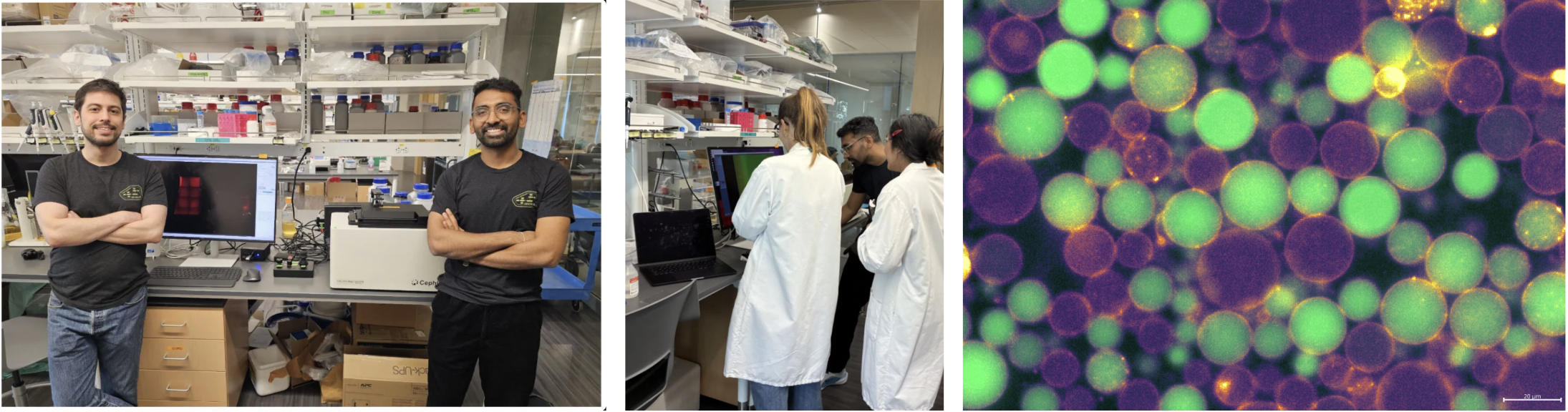
Cal Poly recently announced the launch of Engineering Synthetic Cells, the first university course of its kind, developed in partnership with b.next and powered by Nucleus. Here are my reflections.
Over the last 6 months we’ve been developing what we believe is the first university course dedicated to building synthetic cells. This effort has been led by Javin Oza at Cal Poly SLO and a team of dedicated undergraduate researchers who have been using Nucleus tools and resources to create CHEM 471 “Engineering synthetic cells”. In this course, undergraduate students built synthetic cells from scratch and contributed original experiments throughout the course. Through Nucleus and Developer Notes, we are planning to share course materials and results openly so other educators and labs can build on them.
As the class came to an end last month, I’ve been reflecting on what it means to bring synthetic cells into the undergraduate classroom. And then last week Kate Adamala’s lab announced a preprint on SpudCell, a synthetic cell that can feed, grow, divide, and undergo selection in a single cycle, built entirely from known molecules.
As someone who came into the sciences circuitously through the California community college system, I’ve always felt that the divide between cutting edge science and what is introduced at the undergraduate level, especially universities without R1 research programs, should be reduced. A lot of my role at b.next is helping deliver Nucleus, the shared platform that we develop and steward. This course is a special example of what that actually means. The students of CHEM 471 built Base Cell, which performs transcription and translation, using Nucleus's open specification of Cytosol, the same PURE-based system that underlies more advanced synthetic cells like SpudCell. I hope that future iterations of this course can weave in the SpudCell breakthrough and make tangible discussions of where the field might go and what it implies for technology and society to many more undergraduate audiences.
None of this would be possible without Schmidt Sciences’ support of the Developer Cell project to build out an engineering practice that can operate at scale by building biological systems from the bottom up using known parts; as well as the Astera Institute for their broad support of our open source and open science mission. Thanks also to our partner Cephla Instruments for making automated fluorescence microscopy accessible to the undergraduate teaching lab at Cal Poly.