
The final sprint of the Developer Cells program starts now. Follow along for updates through the next three weeks (September 23 - October 14) as we work with developers in San Francisco to bring new synthetic cell applications to Nucleus.
Last December we kicked off the Developer Cells program with 13 labs across the US and UK to build open, integrated synthetic cell sensor applications in one year. Starting today, developers from the labs are gathering at b.next’s SF-based Nucleus Labs for a three-week intensive engineering sprint (“DevStudio”) to bring their applications across the finish line.
If we’re successful, researchers will be able to access open protocols, documentation, and materials to use and extend the synthetic cell sensor applications. They’ll be available on Nucleus, independently validated and reproduced, and ready to use.
The Applications
As part of the program, two geographically dispersed “nodes” are targeting two sensing applications:
- Chicago node: Six labs across Northwestern University and the University of Michigan working toward a multiplexed sensing material that can function like a QR code for chemicals, read by your phone.
- London node: Six labs across Imperial College London, King’s College London, and University College London building a material capable of alerting a user to the presence of food-spoiling bacteria by changing color.
Over the course of the last 10 months, these applications have evolved, and now the nodes are coming together in this sprint to determine their final application targets.
The Infrastructure
Throughout the program b.next has been providing open-specification Cytosol and integration infrastructure to ensure compatibility across labs. We’ve been documenting and reproducing technologies developed by each lab to ensure that integration is possible and deployable through Nucleus.
The rapid pace of collaborative engineering that will be happening at DevStudio requires purpose-built tools and infrastructure. A developer needs to be able to go from building a cell to testing it with an instrument to analyzing the data to sharing documentation in hours.
We’ve built the infrastructure to make this possible and will be rolling it out during DevStudio to enable the participants. We will be using this sprint to refine this tooling so that it can be made available for the entire synthetic cell community as part of Nucleus.
The People
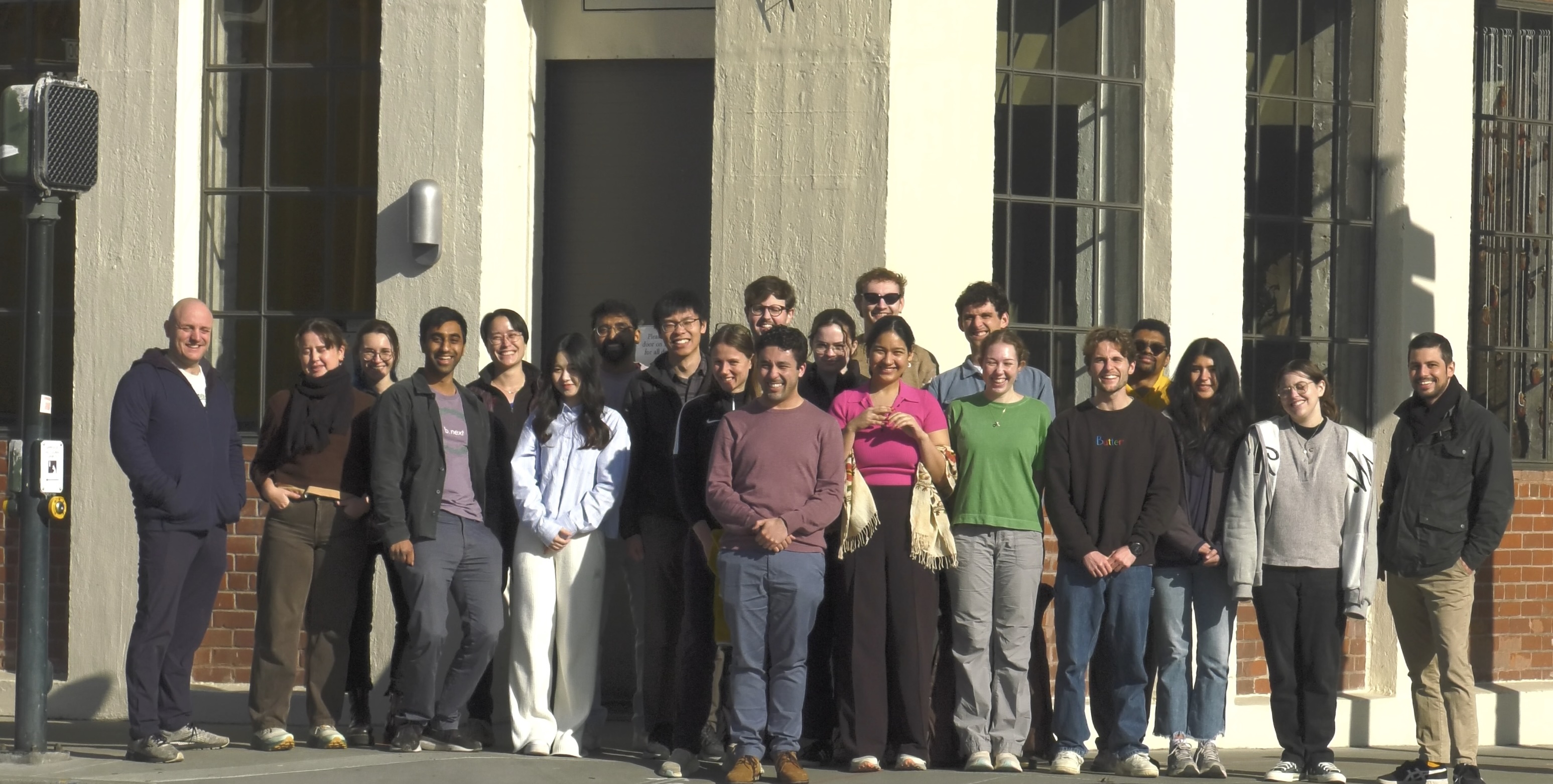
The Developer Cells team includes nearly thirty PIs, graduate students, postdocs, research staff, and engineers who have been working together remote and in-person, attending conferences together, hosting workshops, and becoming a community.
You can tell an engineering field is maturing when its practitioners can walk into a room never having met before and speak the same language. Synthetic cells aren’t there yet. You can hear it in the dialects found across the field: the ~10 micron membrane vesicle structures that every lab works with are referred to as “liposomes", “gee-you-vees”, or “guhvs”. It’s a small linguistic quirk that’s easy to overlook but it signals that we’re still trying to get on the same page.
By gathering a diverse group of synthetic cell engineers to work shoulder to shoulder for three weeks to finish an integrated application, we believe we’ll find much more than a common language. We hope to create a shared culture, a set of practices that will enable our field to work together effectively to build synthetic cells.
Follow Along
We invite everyone to follow along and join us as we complete this one-year experiment in building synthetic cells together. Follow b.next on LinkedIn for real-time updates, and subscribe to our newsletter for weekly updates. We may even livestream a few of the synthetic cell “launches.” And of course, the developers will be sharing their work on Nucleus throughout the event. Please reach out if you want to come visit or get involved!
A huge thanks to Schmidt Sciences, the Astera Institute, and the Sloan Foundation for their support of Nucleus and the Developer Cells program.